
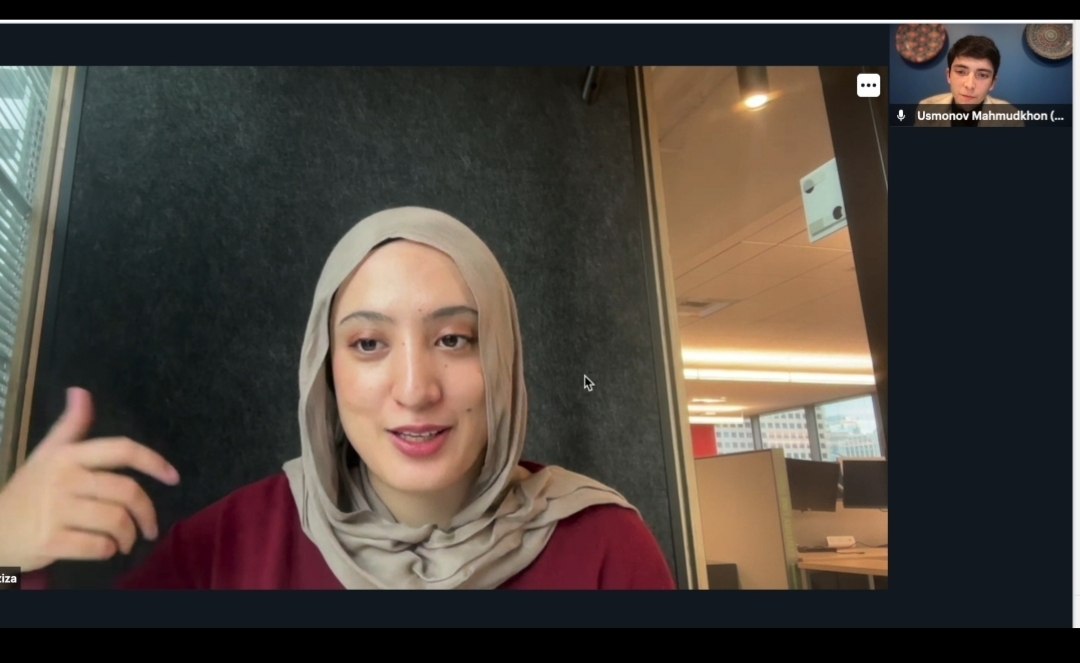
Learning About Responsible AI and Technology: My Conversation with Aziza Mirsaidova
I had the opportunity to speak with Aziza Mirsaidova, whose work is connected to AI, technology ethics, and the evaluation of intelligent systems. This conversation was especially meaningful for me because I am interested in building AI-powered systems, but I also know that building with AI is not only a technical problem. It is also a responsibility problem.
Many students, including myself, often first approach AI from the product side: what can we build, what can we automate, what can we make faster, and how can we make a project look more advanced? But speaking with someone connected to AI ethics and technology evaluation helped me understand that the better question is not only "Can we build it?" The better question is "Should we build it this way, and how do we know it behaves correctly?"
This is especially important now because AI systems are becoming more agentic. They do not only answer questions; they can search, plan, call tools, use browsers, write code, summarize files, and make decisions inside workflows. That makes them powerful, but also risky. A normal chatbot mistake is already a problem. But an agent mistake can affect files, accounts, notifications, schedules, data, and real users.
This directly connects to some of the systems I want to build, such as an eCampus agent for students. At first, the idea sounds simple: log in, check announcements, detect assignments, summarize deadlines, and notify students. But when thinking more seriously, many questions appear. What if the agent misses an assignment? What if it summarizes something incorrectly? What if it exposes private academic data? What if it sends a wrong deadline? What if the system becomes too dependent on automation and students stop checking official sources?
The conversation helped me realize that AI features should not be added just because they sound impressive. They need evaluation. They need boundaries. They need transparency. Users should know when AI is summarizing, when data comes from an official source, and when they need to verify something themselves. AI should assist the user, not silently become the authority.
Another important theme was evaluation. In normal software, testing is already difficult. In AI systems, it is even harder because outputs are not always deterministic. Two responses can be different but both acceptable, or one can sound correct while being wrong. That means AI systems need different evaluation methods: test cases, human review, benchmark tasks, failure examples, feedback loops, and clear success criteria.
For AI agents, evaluation becomes even more complex. It is not enough to check the final answer. We also need to evaluate the steps: what tools the agent used, whether it selected the correct source, whether it respected permissions, whether it handled uncertainty properly, and whether it avoided making unsupported claims. This is a much deeper problem than simply connecting an API to a chat interface.
This conversation also affected how I think about SejongPulse. If I add AI features to a campus platform, the AI should not be a random decoration. It should solve real student problems: finding information, understanding announcements, summarizing documents, helping with navigation, and reducing confusion. But it should do that in a controlled and trustworthy way. For a student platform, trust is more important than flashy AI behavior.
I also learned that responsible technology is not separate from engineering. It is part of engineering. A badly designed system can harm users even if the code works. Privacy, fairness, accuracy, usability, and transparency are technical concerns as much as ethical concerns. They should be considered from the beginning, not added at the end after the product is already built.
For me personally, this conversation made me more serious about how I describe my AI projects. Instead of saying "AI-powered platform" as a buzzword, I want to explain exactly what the AI does, what data it uses, what limitations it has, and how users remain in control. That is a more mature way to build and present AI systems.
Overall, my conversation with Aziza Mirsaidova helped me understand that the future of AI is not only about stronger models. It is about building systems that can be evaluated, trusted, and used responsibly. As a student building AI-related projects, this is a lesson I need to keep applying.
Key Takeaways
- AI systems need evaluation, not just implementation.
- AI agents are powerful because they can act, but that also makes them risky.
- Responsible AI requires transparency, privacy, user control, and clear limitations.
- Campus AI tools should support students without replacing official sources.
- Good AI projects should explain what the system does, how it works, and where it can fail.