
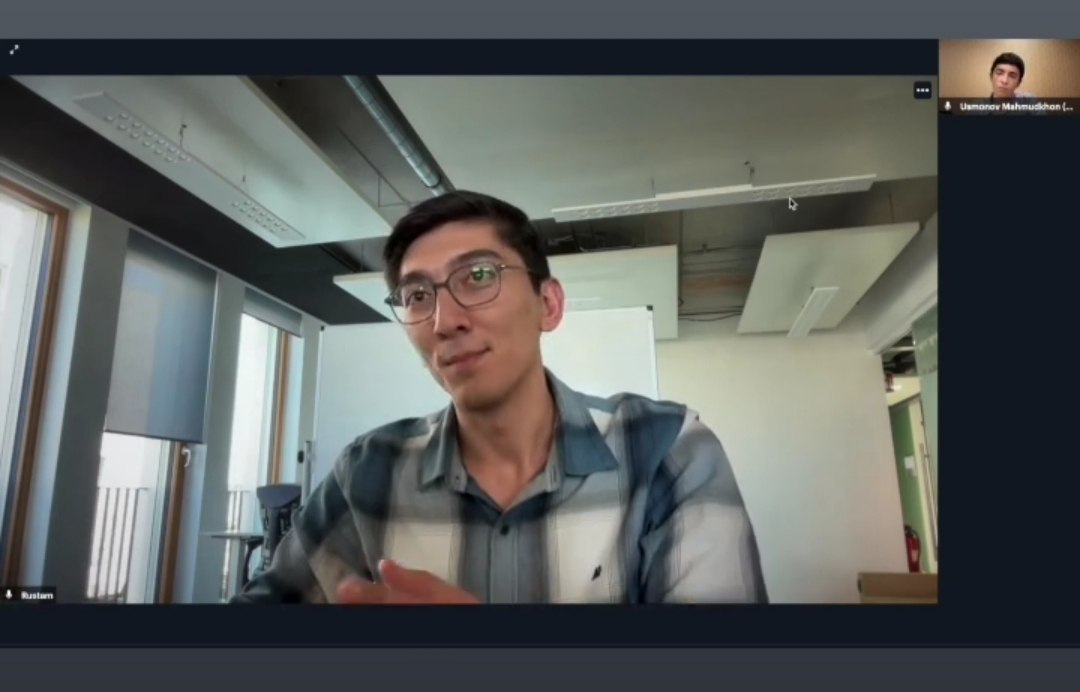
Learning About Software Delivery and Career Growth: My Conversation with Rustam Zokirov
I had the opportunity to speak with Rustam Zokirov, whose professional work is connected to software engineering, end-to-end delivery, and building systems from idea to execution. This conversation was valuable because it helped me think beyond coding and more about what it means to actually deliver software.
Many students think software development means writing code. That is only one part of it. Real software delivery includes understanding the problem, defining requirements, choosing the right architecture, building the system, testing it, deploying it, collecting feedback, and improving it over time. A project is not successful just because the code exists. It is successful when it solves a real problem and can be used reliably.
This idea is important for me because I often work on projects that start as ideas but can become bigger systems. SejongPulse, for example, is not just a website. It is meant to be a campus communication platform for students. That means I need to think about users, authentication, communities, announcements, AI features, documentation, and long-term maintainability. If I only think like a coder, I may build features randomly. If I think like an engineer and product builder, I need to design the system around real user needs.
One lesson from the conversation was the importance of execution. Many people have ideas, but fewer people can turn those ideas into working systems. Execution requires discipline: breaking big goals into smaller tasks, deciding what to build first, avoiding unnecessary complexity, and shipping something usable. A simple working product is usually more valuable than a huge unfinished plan.
We also talked about the importance of communication. In real teams, technical ability is not enough. Engineers need to explain their decisions, document their work, discuss tradeoffs, and collaborate with others. This matters even in personal projects. If I cannot explain what my project does, why it exists, and how it works, then the project will look weaker than it actually is.
This directly applies to my portfolio. A good portfolio should not only show final results. It should explain the process. What problem was I solving? Why did I choose this stack? What were the hardest parts? What tradeoffs did I make? What did I learn? What would I improve next? These questions make a project more credible because they show real thinking behind the work.
Another useful idea was that career growth is built through visible proof. Saying "I am interested in AI" is not strong. Building an AI-powered feature, documenting the architecture, showing a demo, and explaining the limitations is much stronger. Saying "I know backend development" is not strong. Building a working backend with authentication, data modeling, APIs, and deployment is stronger. Proof matters.
This conversation also helped me think about how to choose better projects. A good student project should not only be technically interesting; it should also be explainable and useful. If the project solves a real problem, it becomes easier to discuss in interviews, portfolio reviews, and mentorship conversations. Projects like SejongPulse or an eCampus agent are stronger than random clones because they are connected to real student problems.
I also learned that simplicity is not weakness. Beginners often think a project has to use many technologies to look impressive. But too many tools can make a project messy. A well-designed system with a clear purpose is better than a complicated system that nobody understands. Good software delivery means choosing what is necessary and ignoring what is not.
For my own growth, this conversation pushed me to focus more on finishing and presenting projects properly. It is not enough to build 70 percent of something and move on. I need to complete the core features, write documentation, create screenshots, prepare demos, and explain the technical decisions clearly. That is how a project becomes portfolio-quality.
Overall, my conversation with Rustam Zokirov helped me understand that software engineering is not only about code. It is about delivery, clarity, communication, and building systems that create value. That is the kind of mindset I want to apply to my future projects.
Key Takeaways
- Software delivery includes problem definition, design, implementation, testing, deployment, and improvement.
- Execution matters more than just having ideas.
- Strong projects need clear explanations, not only screenshots.
- Career growth depends on visible proof of real work.
- Simple, finished, useful systems are better than overcomplicated unfinished projects.